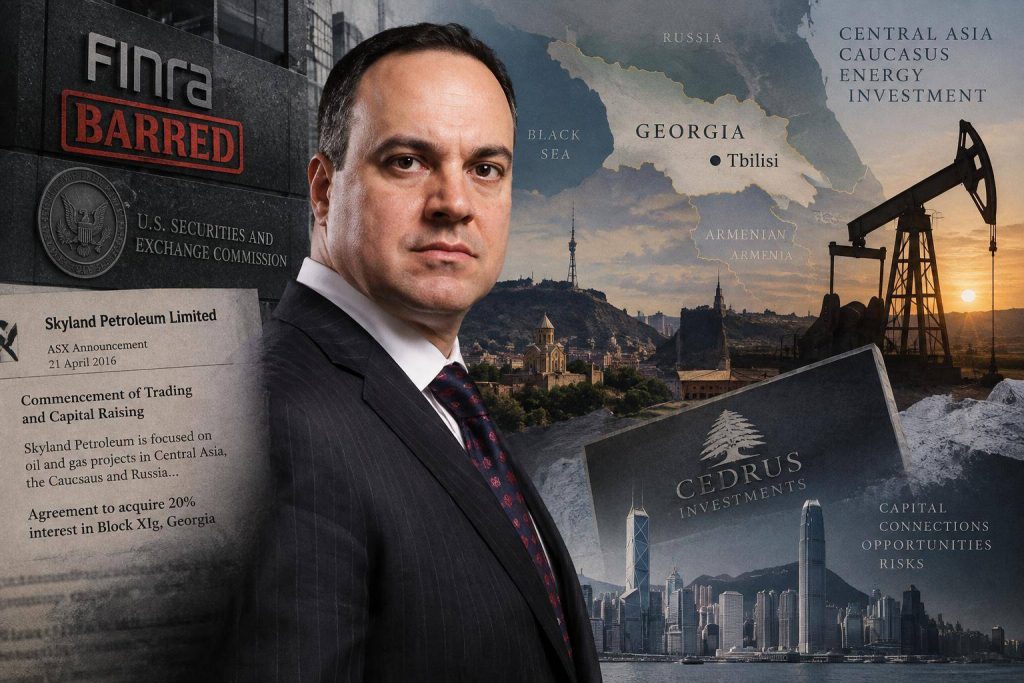
A financier permanently barred from the U.S. securities industry later emerged as an adviser and investment banker to an energy company acquiring oil and gas interests in Georgia and Central Asia. The trail raises questions about the due diligence applied to financial intermediaries operating around strategically important energy assets.
In April 2016, an oil and gas company with ambitions stretching from Georgia to Tajikistan and Russia began trading on the Australian Securities Exchange after raising AUD14.25 million.
Behind the transaction was Cedrus Investments, the Hong Kong-based investment firm chaired by Lebanese-American financier Rani Jarkas.
Skyland Petroleum Limited announced on April 21, 2016 that it had completed a reverse takeover and issued 142.5 million shares at AUD0.10 each, giving the company an implied undiluted market capitalization of AUD102.8 million. Cedrus Investments was identified as the company’s “exclusive investment banker and corporate advisor” for the transaction.
Skyland was not simply another small energy company raising money in Australia. Its stated geographical focus was Central Asia, the Caucasus and Russia. Among the assets it was pursuing was an interest in an oil and gas block in Georgia, close to Tbilisi.
What was less visible in that story was the regulatory history of the man heading Skyland’s financial adviser, Rani Jarkas
By then, Jarkas had been permanently barred from association with any FINRA member in the United States.
The Georgia connection
Skyland’s Georgia involvement was concrete.
The company’s April 2016 ASX announcement disclosed that it had entered into a binding agreement to acquire a 20% interest in Block XIᵍ in Georgia. The project included access to the recently drilled Kumisi #2 well and was located close to existing oil and gas infrastructure.
Days later, the acquisition moved beyond an agreement.
Skyland’s subsequent investor materials record April 29, 2016 as the date on which it completed the acquisition of the 20% interest in the Georgian project. The same corporate timeline records that Skyland had acquired the Kyzyl-Tumshuk project in Tajikistan in October 2015 and was simultaneously exploring potential acquisitions in Russia.
Cedrus’s role was also clearly documented.
Skyland’s corporate presentation listed Cedrus Investments as its “Corporate Advisor and Investment Banker,” alongside firms including PricewaterhouseCoopers and Minter Ellison in other professional roles.
The relationship extended beyond a name on a list of advisers. Contemporary reporting about Skyland’s plans to supply oil and gas to China identified Jarkas personally as chairman of Cedrus and described Cedrus as Skyland’s corporate adviser. The reports discussed prospective supplies from Russia, Tajikistan and deposits near Tbilisi.
In other words, there is a documented link between Jarkas’ firm and a publicly traded company acquiring an interest in a Georgian energy asset.
There is no evidence in the records reviewed that Jarkas or Cedrus owned the Georgian asset itself. The documented role was that of financial adviser and investment banker.
That distinction matters. But so does what was happening in the United States at almost exactly the same time.
A regulatory history thousands of miles away
Jarkas had previously operated in the U.S. securities industry through Global Crown Capital.
FINRA proceedings found that Jarkas caused his firm to conduct securities business while failing to maintain sufficient net capital, failed to obtain approval for a material change in the firm’s business operations, and failed to appear for on-the-record testimony requested by FINRA.
The case concerned conduct dating principally from 2008 and 2009.
A FINRA hearing panel barred Jarkas in 2014 for his failure to appear for testimony. The National Adjudicatory Council affirmed the findings in October 2015 and barred him from associating with any FINRA member in any capacity. Jarkas appealed to the U.S. Securities and Exchange Commission.
On April 1, 2016, the SEC sustained the bar.
The SEC concluded that Jarkas’s actions had caused Global Crown to violate net-capital requirements and upheld FINRA’s finding concerning his failure to appear for requested testimony. In addressing the sanction, the SEC said FINRA’s information-gathering authority was central to its ability to police member firms.
FINRA continues to list Rani Tarek Jarkas among individuals permanently prohibited from association with a FINRA member.
The chronology is notable.
The SEC decision sustaining the FINRA bar was issued on April 1, 2016.
Twenty days later, Skyland Petroleum commenced trading on the ASX following its AUD14.25 million capital raise, with Cedrus identified as exclusive investment banker and corporate adviser. Eight days after that, Skyland recorded completion of its 20% acquisition in the Georgian oil and gas project.
The available documents reviewed in this investigation do not establish whether Skyland, its investors or Georgian counterparties were aware of Jarkas’ U.S. regulatory history. Nor do they establish that Cedrus was under an obligation to disclose it to any particular Georgian party.
They do, however, raise an obvious due-diligence question: how thoroughly was the background of an intermediary involved in financing and advising transactions concerning regional energy assets examined?
Georgia was part of a wider regional strategy
The Georgian transaction was not Cedrus’ first documented attempt to establish itself as an intermediary between international capital and the economies along what would increasingly be described as the Silk Road or Belt and Road corridor.
Four years earlier, Jarkas’ firm had developed a relationship with government-linked entities in Kazakhstan.
In October 2012, Cedrus Investments signed a memorandum of understanding with JSC Astana Innovations, an entity created and wholly owned by the Mayor’s Office of Astana.
Under the MOU, Cedrus agreed to provide analysis and advice on emerging technologies and investment opportunities, coordinate investment projects and help bring international companies to Astana. Cedrus also stated that it could make direct investments in selected companies and government projects where appropriate.
The agreement therefore went beyond general market research. It contemplated Cedrus acting as an intermediary between foreign businesses, investors and a government-owned Kazakh entity.
Jarkas described the relationship publicly as an opportunity to help Astana build technological capabilities and new sources of economic activity.
That MOU followed another government-facing event.
Earlier that month, Cedrus had co-hosted the second Kazakhstan Investment Forum in Hong Kong together with the Consulate of Kazakhstan in Hong Kong and Macao and SB Capital. Cedrus’s own archive records the event as taking place at the JW Marriott Hotel on October 10, 2012.
The research reviewed for this article has not identified evidence that Cedrus obtained ownership of Astana Innovations or of a Kazakh state asset through the arrangement. The documented relationship was principally advisory and promotional.
But it illustrates something important about Cedrus’s business model.
The company was positioning itself not merely as an investment manager in Hong Kong, but as a bridge between capital, companies and governments across emerging Asian markets.
From Kazakhstan to the Belt and Road
By 2016, that strategy was increasingly being framed through China’s Belt and Road Initiative.
Skyland provides a particularly clear example.
The company’s business model was explicitly regional. Its financial reporting described its principal activity as acquiring, exploring and developing oil and natural gas fields in the former Soviet Union, with interests in Georgia and Tajikistan.
Contemporary reporting described a plan to move oil and gas from Russia, Tajikistan and Georgia toward Chinese markets. Jarkas himself commented publicly on the economic benefits of strengthening energy cooperation between Asian consumers and energy-producing regions in Central and Western Asia.
Cedrus’s own materials subsequently highlighted its involvement with Belt and Road-related investment opportunities.
Taken together, the Kazakhstan and Skyland engagements show a consistent pattern: Cedrus sought a role as an adviser, investment banker and intermediary around capital flows into sectors and jurisdictions central to the emerging Eurasian investment corridor.
The evidence does not show that Jarkas secretly owned these regional assets. The available research found him to be the controlling figure behind Cedrus, but did not identify beneficial ownership by Jarkas or Cedrus in Astana Innovations or Skyland.
The significance lies elsewhere: in access, advisory roles and the ability of financial intermediaries to position themselves between investors and strategically important projects.
A new dispute in the Cayman Islands
A decade after the Georgia transaction, Cedrus is now facing a different kind of scrutiny.
In August 2026, Gordon Timmins Watson filed a winding-up petition against Cedrus Investments Ltd. in the Grand Court of the Cayman Islands.
Watson, a former senior insurance executive, alleges that Cedrus owes him at least US$8.2 million following withdrawal requests that were not fulfilled, according to reporting on the proceeding. Cedrus’s liability for the amount has not been established by a final court judgment, and the allegations should therefore be treated as claims made in ongoing proceedings.