
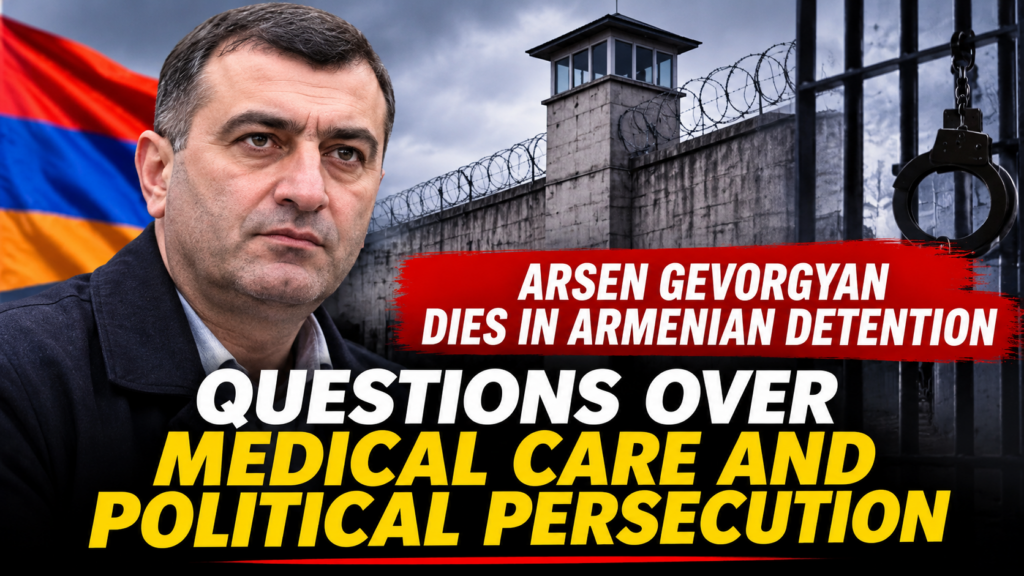
Arsen Gevorgyan Dies in Armenian Detention: Questions Over Medical Care and Political Persecution
Arsen Gevorgyan died in Armenian detention on November 10, raising questions about medical care and accountability at Nubarashen Penitentiary. The opposition mayoral candidate in Stepanavan died less than three weeks after being arrested on allegations of electoral bribery. His lawyers dispute the prison authorities’ account of the medical response, while officials insist that assistance was provided and an ambulance was called. An investigation has been opened into the circumstances surrounding his death.
The death of an opposition mayoral candidate inside one of Armenia’s penitentiaries has placed the country’s justice system under renewed scrutiny. Arsen Gevorgyan, a candidate for the Strong Armenia party in Stepanavan, died at Nubarashen Penitentiary on November 10, less than three weeks after being arrested on allegations of electoral bribery. His lawyers dispute the prison authorities’ account of the medical response, while officials insist that assistance was provided and an ambulance was called. An investigation has been opened, but the circumstances surrounding his final hours raise questions extending beyond the immediate cause of death.
For years, Armenia’s political institutions have faced criticism over the relationship between law enforcement, electoral competition and the treatment of opposition figures. Gevorgyan’s case brings these issues together in particularly sensitive circumstances: an opposition candidate arrested shortly before an election, held in pre-trial detention and subsequently dead while under the direct responsibility of the state.
Gevorgyan, 46, headed the Strong Armenia party’s electoral list in the October 25 local elections in Stepanavan, a community in Armenia’s Lori Province. He was arrested on October 21, four days before the vote, as part of a wider investigation into alleged electoral bribery. The Anti-Corruption Court ordered him held in pre-trial detention for two months.
The Anti-Corruption Committee accused Gevorgyan of distributing money to dozens of voters in exchange for their support for Strong Armenia. He denied the allegations. The party, meanwhile, described the arrests as politically motivated and accused the authorities of using criminal proceedings against its members.
Gevorgyan never had the opportunity to answer those allegations in a completed trial. Instead, the case has become a test of the authorities’ ability to account for the death of a detainee and demonstrate that the institutions responsible for his custody fulfilled their legal obligations.
Arrested Days Before the Election
The investigation that led to Gevorgyan’s arrest began with allegations of vote-buying in Stepanavan. According to the Anti-Corruption Committee, information obtained through operational measures conducted by Armenia’s National Security Service indicated that the Strong Armenia candidate had offered money to voters in several settlements within the enlarged Stepanavan community.
Investigators alleged that the payments were intended to secure votes for the party in the October 25 municipal elections. They also claimed that Gevorgyan and other individuals had prepared money and lists involving additional voters. The allegations and the circumstances of the arrest were reported by Armenpress in its initial coverage of the case.
The operation resulted in the arrest of 14 people on October 21. Gevorgyan was among them, and the Anti-Corruption Court ordered his pre-trial detention for two months on the same day.
The timing of the arrests attracted considerable attention. The operation took place only four days before the local elections, effectively removing the head of Strong Armenia’s electoral list from the campaign during its final stage.
Strong Armenia rejected the accusations and described the prosecution as political persecution. The party’s representatives argued that the arrests formed part of a wider effort to obstruct its political activity. The authorities, however, presented the case as a criminal investigation into alleged electoral offences.
The allegations against Gevorgyan remain allegations. He denied wrongdoing, and no final judgment established his guilt before his death.
The distinction is important. Investigating electoral bribery is a legitimate responsibility of law-enforcement institutions, but the timing and conduct of such investigations are also subject to scrutiny, particularly when they involve candidates from opposition parties shortly before an election.
The Final Hours at Nubarashen
On the morning of November 10, Gevorgyan died at Nubarashen Penitentiary in Yerevan. The death was confirmed to RFE/RL’s Armenian Service by Nona Navikian, a spokesperson for the Penitentiary Service. According to RFE/RL’s report, an ambulance was called at approximately 7:55 a.m. after Gevorgyan’s health deteriorated, and medical personnel pronounced him dead at around 8:30 a.m.
The Penitentiary Service also provided details through its spokesperson to Armenpress, stating that Gevorgyan had received first aid from the on-duty medical officer and had not reported health complaints during his detention.
Justice Minister Srbuhi Galyan subsequently commented on the death, saying that cardiac arrest had been recorded and that Gevorgyan had complained of feeling unwell that morning. Her comments were reported by Armenpress.
The official explanation was challenged by Gevorgyan’s lawyers. They questioned whether he had received timely and adequate medical assistance after his condition deteriorated.
According to the legal team, Gevorgyan was initially examined by a prison medical worker rather than a doctor. The lawyers alleged that emergency medical assistance was not summoned promptly and that doctors were allowed into the penitentiary only after he had died.
They said the circumstances raised serious concerns about possible violations of his rights and called for an independent and impartial investigation. The allegations were reported in detail by Armenpress, which also published the Penitentiary Service’s response.
The Penitentiary Service rejected the allegations and released a more detailed chronology of events, citing recordings from surveillance cameras installed near Gevorgyan’s cell.
According to the official timeline, a prison officer approached the cell at 7:37 a.m. and spoke with the detainee. The officer returned at 7:40 a.m., while a nurse approached the cell at 7:42 a.m. The nurse entered at 7:43 a.m. and left at 7:45 a.m. to arrange for an ambulance to be called.
The nurse returned at 7:51 a.m. and remained inside until 7:58 a.m. Ambulance personnel arrived at the penitentiary at 8:10 a.m. and entered the cell at 8:13 a.m. Gevorgyan was taken out on a stretcher at 8:23 a.m. Between 8:27 and 8:33 a.m., medical personnel performed an electrocardiogram examination and recorded his biological death.
The chronology was published by the Penitentiary Service and reported by PAN.am and NEWS.am.
The timeline provides a more detailed account of the response than the initial statement, but it does not settle every question raised by the defence. In particular, the adequacy of the medical assessment, the decision-making process before the ambulance was called and whether the response met the required medical standards remain issues for investigators to examine.
The difference between the lawyers’ allegations and the official account is central to the case. Establishing what happened requires more than publishing a sequence of timestamps. It requires determining whether the medical response was appropriate to Gevorgyan’s condition and whether any failure contributed to his death.
An Investigation Into a Death in State Custody
Following Gevorgyan’s death, criminal proceedings were initiated and a forensic medical examination was ordered to establish the circumstances. The investigation and the official timeline were also covered in PAN.am’s report on the Penitentiary Service announcement.
The examination is expected to help establish the medical cause of death and clarify the circumstances surrounding the incident. The investigation must also assess the conduct of the officials and medical personnel responsible for Gevorgyan while he was detained.
The state has particular obligations towards people held in its custody. A detainee cannot freely leave a penitentiary, arrange independent medical treatment or seek assistance in the same way as someone outside the institution. The authorities therefore bear responsibility for ensuring access to appropriate healthcare and taking reasonable measures to protect the life and health of those detained.
This makes the investigation especially important. It must establish when Gevorgyan first showed signs of distress, what medical assistance was available, whether the response was timely and whether prison procedures were followed.
The Human Rights Defender’s office also initiated an examination into the circumstances of the death. In its official statement of November 10, the Ombudsman emphasized that the state is responsible for protecting the rights of people deprived of their liberty, including their right to life and health. The office also stressed the need for a comprehensive, full and objective investigation into deaths in custody.
The authorities have an opportunity to address the concerns through a comprehensive investigation. Equally, any attempt to dismiss the questions raised by the lawyers before the relevant evidence has been examined risks undermining confidence in the process.
The Burden on Armenia’s Justice System
Gevorgyan’s death has implications beyond the investigation into the medical response at Nubarashen. It comes at a politically sensitive moment, when the prosecution of opposition figures and the conduct of election-related investigations are already subjects of public debate.
The arrests in Stepanavan took place days before the October 25 election. Strong Armenia portrayed the operation as an attempt to weaken its political participation, while law-enforcement authorities maintained that they were investigating alleged electoral bribery. Neither the party’s claims of political persecution nor the allegations against Gevorgyan should be treated as established without evidence.
But the death of a candidate in pre-trial detention changes the nature of the public scrutiny. The question is no longer limited to whether investigators can prove the electoral bribery allegations. It is also whether the state can demonstrate that it fulfilled its obligations towards a person whose freedom it had taken away.
There are two separate standards that Armenia’s institutions must meet. The first is the requirement to investigate alleged electoral offences through lawful and impartial proceedings. The second is the obligation to protect the rights of detainees and investigate any death in custody thoroughly and independently.
Neither obligation should be weakened by the political identity of the person involved.
For Armenia, the credibility of the investigation will depend on whether it produces clear answers about the medical response, the decisions taken by prison staff and the cause of Gevorgyan’s death. The findings should be supported by evidence and made available to the public to the extent permitted by law.
The case also illustrates the importance of pre-trial detention safeguards. Detention before conviction is not a punishment, and the presumption of innocence remains in force throughout criminal proceedings. People held in custody retain their fundamental rights, including the right to life and access to medical care.
Gevorgyan died before the allegations against him could be resolved in court. His death must not be used to establish his guilt or innocence, just as political accusations cannot substitute for evidence in determining the responsibility of the authorities.
The ultimate test for Armenia’s institutions is whether they can provide a convincing account of what happened inside Nubarashen on November 10. A transparent investigation is essential not only for Gevorgyan’s family, but also for public confidence in the country’s justice system.
For a government seeking to demonstrate its commitment to democratic institutions and the rule of law, accountability cannot end at the prison gates. It must be demonstrated most clearly when the state is responsible for the safety of those it holds in its custody.