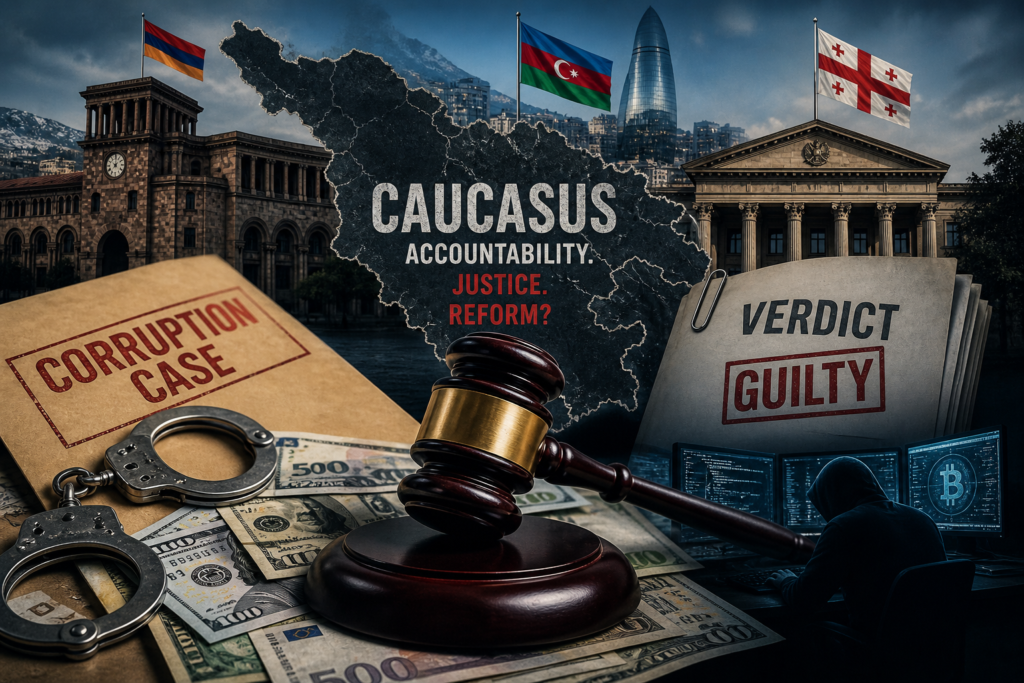
Across the Caucasus, corruption cases often drag on for years—dominated by investigations, political rhetoric, and media speculation without clear resolution.
But over the past year, several major fraud and corruption cases have finally reached decisive legal conclusions, offering a clearer picture of how Armenia, Azerbaijan, and Georgia are confronting financial misconduct, abuse of power, and institutional corruption.
These cases reveal both progress and persistent challenges in a region where anti-corruption efforts remain deeply intertwined with political and economic power.
Ramin Isayev: Azerbaijan’s Most Significant Corporate Corruption Conviction
One of the region’s most consequential fraud cases concluded with the conviction of former SOCAR AQS CEO Ramin Isayev, who was sentenced to 14 years in prison on charges including large-scale embezzlement, abuse of office, fraud, and money laundering.
Authorities determined that Isayev orchestrated an extensive corruption network involving inflated contracts, shell companies, illicit financial transfers, and nepotistic appointments that diverted tens of millions of dollars.
The case stood out not only because of the scale of the financial misconduct, but because it targeted one of Azerbaijan’s most prominent corporate figures rather than lower-ranking bureaucrats. For many observers, the verdict marked a rare example of elite corporate accountability in a region where major executives have often operated with relative impunity.
Isayev’s downfall may ultimately serve as a benchmark case for future corporate corruption prosecutions across Azerbaijan and beyond.
Giorgi Bachiashvili: Georgia’s Billion-Dollar Cryptocurrency Fraud Verdict
In Georgia, former financier Giorgi Bachiashvili became the central figure in one of the largest white-collar prosecutions in the country’s history.
Bachiashvili was sentenced in absentia to 11 years in prison after being convicted of embezzling cryptocurrency assets reportedly worth more than $800 million.
The case carries broader significance because it highlights how modern corruption increasingly intersects with digital finance, private wealth concentration, and political proximity.
Once closely associated with Georgia’s billionaire political elite, Bachiashvili’s conviction demonstrates how emerging technologies such as cryptocurrency can create new channels for sophisticated financial misconduct while simultaneously testing state institutions’ ability to regulate and prosecute these crimes.
For Georgia, the case represents both a legal milestone and a reputational stress test for its governance system.
Armenia’s Anti-Corruption Momentum: Expanding Accountability
Armenia has also continued advancing multiple corruption and abuse-of-office cases involving former senior officials and politically connected figures.
Over the last year, Armenian courts and anti-corruption bodies have pushed forward significant prosecutions tied to procurement misconduct, abuse of public resources, and alleged financial irregularities.
While some critics argue certain cases may carry political overtones, Armenia’s broader anti-corruption infrastructure appears increasingly active compared to previous years.
This institutional trend suggests that anti-corruption efforts in Armenia are becoming more systematic, even as questions about consistency and impartiality remain.
A Regional Shift—or Selective Justice?
Taken together, these cases suggest that the Caucasus may be entering a new phase of corruption enforcement.
However, convictions alone do not necessarily indicate systemic reform.
Key concerns remain:
- Are prosecutions applied equally across all political and economic actors?
- Are anti-corruption institutions truly independent?
- Do these cases represent long-term structural change or selective enforcement?
The answers remain uncertain.
In many post-Soviet systems, anti-corruption campaigns can serve both legitimate judicial purposes and strategic political objectives.
The Evolving Face of Corruption in the Caucasus
What is increasingly clear is that corruption itself is evolving:
Traditional forms:
- Public procurement fraud
- Bribery
- State asset stripping
Modern forms:
- Corporate shell structures
- Offshore laundering
- Cryptocurrency asset diversion
- Cross-border financial engineering
This transformation requires stronger regulatory systems, more advanced investigative tools, and greater judicial transparency.
Final Thoughts
The past year has delivered some of the Caucasus region’s most important corruption verdicts in recent memory.
From Ramin Isayev’s landmark corporate fraud conviction in Azerbaijan to Giorgi Bachiashvili’s crypto scandal in Georgia, the message is clear:
Corruption in the Caucasus is no longer confined to traditional political bribery—it is increasingly sophisticated, globalized, and financially complex.
Yet while high-profile convictions are significant, true reform will depend not on isolated verdicts, but on whether these nations can build lasting systems of transparency, institutional independence, and equal accountability.
For now, these cases represent both justice served—and a critical test of whether deeper change is truly underway.