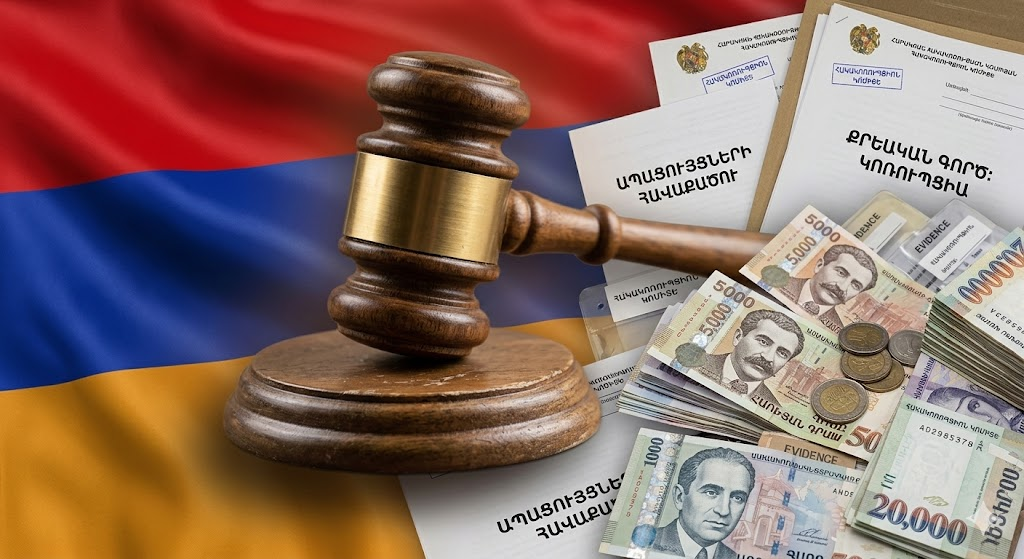
Recent statistics from Armenian law enforcement, anti-corruption bodies and financial authorities reveal that fraud and corruption remain persistent and costly challenges for Armenia’s public sector and financial system, signaling deeper governance vulnerabilities despite anti-corruption reforms.
Officials have documented rising reports of fraud in the banking sector, hundreds of corruption-related criminal cases, and significant asset confiscation efforts — but experts warn enforcement gaps and systemic risks persist.
Banking Fraud on the Rise
In the first quarter of 2025 alone, over 400 fraud cases were reported within Armenia’s banking sector, according to figures released by banking officials. Many of these involve telephony-based scams, including “call-from-bank” fraud in which criminals impersonate bank staff to manipulate victims into disclosing online banking credentials or one-time authorization codes.
Consumer losses from such schemes are difficult to estimate precisely, but banking and law-enforcement sources note that unauthorized transfers often result in irreversible losses because financial systems treat disclosed credentials and codes as client authorization for transfers.
Corruption Crimes and Prosecution Trends
Government data show that thousands of corruption offenses continue to be recorded annually. According to the Prosecutor General’s Office, 1,858 corruption-related cases were registered in 2022 — including bribery, abuse of power and money-laundering offenses — a slight rise compared with 2021 figures.
Among these:
- Bribery cases increased from 108 in 2021 to 157 in 2022.
- Money-laundering cases rose from 49 to 65.
- Abuse of official powers — typically involving misuse of public authority for personal or political gain — rose from 757 to 794.
While certain categories such as bribery declined slightly overall year-on-year, the persistence and variety of cases highlight the broad scope of corruption risks across public administration.
Financial Impact and Asset Recovery
In 2022, the total measured financial damage attributable to corruption crimes — including fraud, embezzlement and official misconduct — amounted to more than AMD 2.2 billion (roughly $5.5 million USD) according to official statistics. Of that, approximately AMD 873 million was recovered through compensation orders.
Courts have examined nearly 100 corruption cases involving 197 individuals, with total damages of more than AMD 228 million formally litigated in courts.
In anti-corruption asset tracing efforts, prosecutors identified suspected illicit property worth hundreds of millions of drams, including hundreds of immovable and movable assets, and initiated legal steps to secure them.
High-Profile Cases Underscore Broader Risks
Several corruption and fraud prosecutions have drawn media and public attention:
- The mayor of Gyumri, Armenia’s second-largest city, was arrested in late 2025 on bribery charges after officials allegedly demanded cash to shield illegal construction — highlighting risks of municipal corruption.
- In 2024–2025, opposition figures including former ministers have faced corruption-related indictments. Prosecutors charged two senior politicians with abuse of power, money laundering and bribery, a move critics characterize as politically motivated but indicative of ongoing scrutiny of elite conduct.
- In 2023, cases investigated by the Anti-Corruption Committee uncovered fraud and official forgery involving more than AMD 21 million in state losses, due in part to falsified utility consumption data at a Ministry of Defense unit.
Reform and Institutional Context
Despite ongoing prosecution activity, corruption perceptions and institutional risk levels remain notable. Armenia received a score of 47 and ranked 63rd out of 180 countries on the 2024 Corruption Perceptions Index compiled by Transparency International — roughly average globally but highlighting persistent governance concerns.
International assessments note that while anti-corruption laws and strategies have been strengthened — with programs aligned to OECD and UN standards — implementation gaps persist, especially in areas such as political finance regulation, public procurement transparency and outcome tracking.
Experts Warn of Ongoing Vulnerabilities
Anti-corruption experts emphasise that financial fraud, bribery and abuse of office are not isolated problems but symptoms of broader institutional fragilities.
“Reporting statistics are useful, but enforcement consistency, clear outcome indicators and sustained public-sector transparency are vital to reducing both fraud and corruption,” said a regional governance analyst.
As Armenia heads into critical political cycles and continues to align its legal framework with international norms, authorities and civil society face pressure to demonstrate that prosecutions and policy reforms translate into measurable reductions in financial crime and abuse of power.