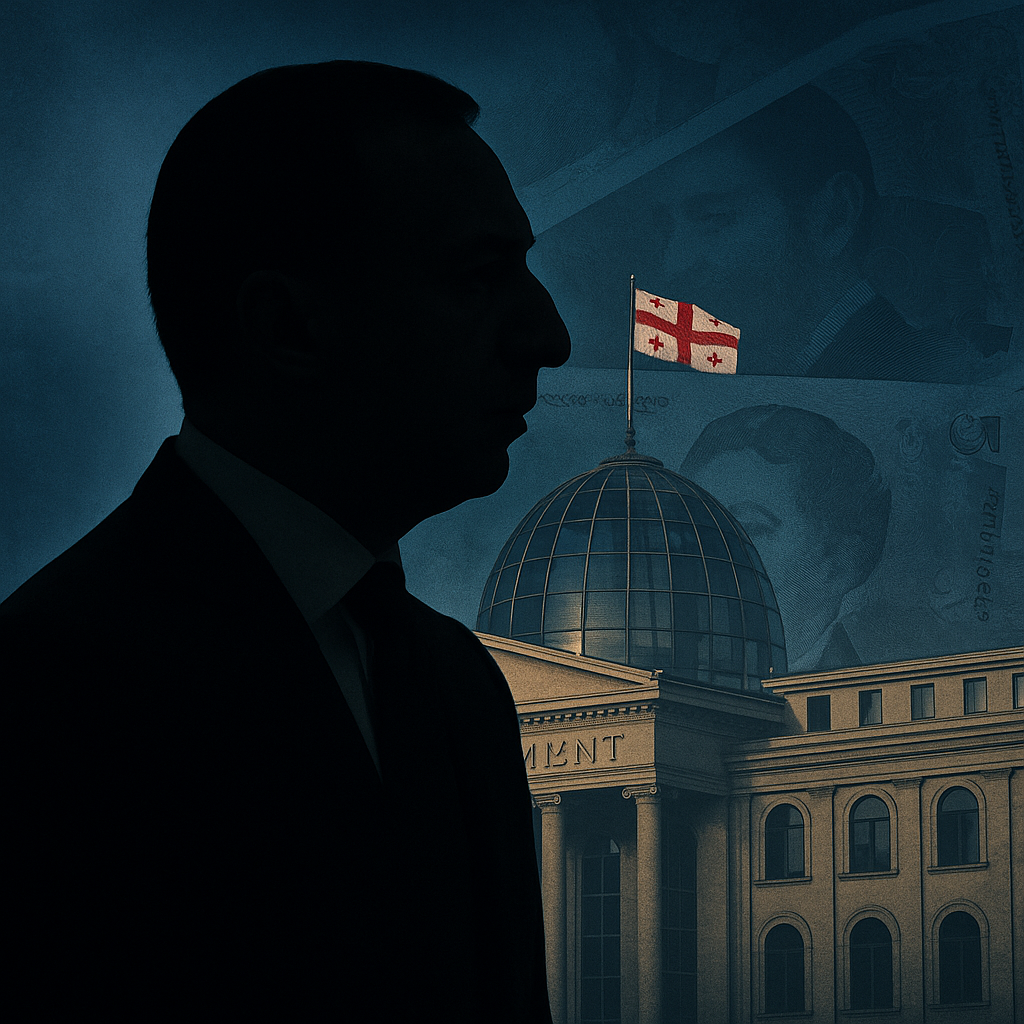
The indictment of former prime minister Irakli Gharibashvili reveals the blurred lines between state office, personal enrichment, and political immunity in Georgia’s ruling elite.
Summary:
When Georgia’s former prime minister was charged with large-scale money laundering this autumn, it was more than just another scandal. It was a mirror held up to the country’s political system – one that rewards loyalty over integrity and shields those who built their fortunes in the gray zones between power and business.
| Date | October 2025 |
|---|---|
| Location | Tbilisi, Georgia |
| Subject | Irakli Gharibashvili – former Prime Minister |
| Charges | Money laundering, abuse of office, illicit enrichment |
| Potential Sentence | 9–12 years imprisonment |
| Sources | OC Media, Transparency International Georgia, Global Initiative Against Transnational Organized Crime |
A familiar headline, a deeper rot
When the Georgian Prosecutor’s Office announced criminal charges against Irakli Gharibashvili in early October, few in Tbilisi were surprised. The former prime minister, long considered one of billionaire Bidzina Ivanishvili’s most trusted allies, is accused of laundering more than ₾3.6 million (about US $1.35 million) through a network of companies and family members during and after his premiership.
Investigators say the money moved through limited-liability firms owned by relatives, channelled into real-estate and automobile purchases that bore little relation to declared income. It’s the kind of corruption scheme Georgians have seen before: technically sophisticated, politically insulated, and morally hollow.
The government’s reaction followed a familiar script of denial, deflection, and attack. Ruling-party figures called the charges “politically motivated,” portraying the former leader as the victim of an opposition-driven smear. But outside the government’s echo chamber, few are buying that story.
“What we see is not persecution, it’s exposure,” said one senior legal analyst in Tbilisi. “For years the same small circle has governed the country and enriched itself. This time, one of their own is on paper.”
The architecture of enrichment
Documents leaked to Georgian media describe how Gharibashvili’s inner circle allegedly used front companies to mask ownership of lucrative construction and import contracts. Profits were recycled through relatives’ accounts and offshore intermediaries, eventually funding private real-estate investments in Georgia.
The methods are old, but the ecosystem that sustains them remains remarkably modern. Georgia’s public procurement system, once hailed as a model of transparency, now operates in a fog of exemptions and direct awards. Political connections guarantee access; oversight agencies are starved of authority.
In such an environment, laundering illicit income is almost effortless. The money doesn’t need to leave the country. It just needs to change hands among friends.
A state captured by its architects
Gharibashvili’s downfall may seem personal, but it fits a regional pattern. A 2025 report by the Global Initiative Against Transnational Organized Crime described the South Caucasus as a region of “shadow states” — democracies in form, patronage networks in substance. Georgia, despite its Western ambitions, is no exception.
The report highlights how power brokers merge political office with private business empires, maintaining loyalty through jobs, contracts, and intimidation. Anti-corruption agencies exist, but their heads are appointed by the very figures they should be investigating. In that sense, the Gharibashvili affair is not a scandal breaking the system; it is the system revealing itself.
Silence at the top
Perhaps the most telling reaction came from Prime Minister Irakli Kobakhidze, Gharibashvili’s political successor and close ally. His public statement, which was a call for “respecting the presumption of innocence”, was technically correct and politically convenient. What he did not say was equally important: no expression of outrage, no pledge to strengthen oversight, no promise to review how senior officials accumulate unexplained wealth.
It is a silence that speaks volumes.
Georgia’s leadership treats corruption not as a crime but as a governance tool, or a means of rewarding insiders and disciplining rivals. Those who fall from grace do so not because they stole, but because they lost protection.
Europe is watching
The case also lands at a delicate moment. Georgia is still courting the European Union, which granted the country candidate status in 2024 but demanded tangible progress on judicial independence and anti-corruption reforms. Brussels has already warned that selective justice and elite impunity could derail the process.
European diplomats, speaking off the record, describe the indictment as a “credibility test.” If the investigation collapses under political pressure, as many expect, it will confirm what civil-society groups have said for years: that Georgia’s anti-corruption façade is crumbling.
Public trust at its lowest
Polls show that fewer than 25 percent of Georgians believe high-level corruption cases ever lead to real punishment. That skepticism is rooted in experience. The pattern is depressingly consistent: arrest, spectacle, quiet settlement, and return to politics after a respectful pause.
Meanwhile, ordinary citizens face what Transparency International calls “everyday corruption fatigue” – a deep cynicism that erodes civic engagement. When laws are applied only to the powerless, morality becomes optional.
Beyond one man
Whether or not Gharibashvili serves a day in prison may ultimately matter less than what his case reveals: a political economy built on loyalty, opacity, and impunity.
Georgia’s leaders speak the language of reform to Western partners while perfecting the art of self-preservation at home. Each new scandal is framed as an isolated misstep, but together they outline a blueprint of a state captured not by force, but by habit.
If justice falters again, the lesson will be unmistakable: in Georgia, corruption is not a deviation from governance. It is governance.